Introduction – Ranking #1 Isn’t What It Used to Be
For years, digital growth followed a simple rule. Rank higher on Google, get more traffic, convert more customers. That logic shaped entire strategies. Businesses invested heavily in SEO with one clear objective: reach the top of search results. Agencies were hired and measured by it. Success was defined by a number — position one, page one, above the fold.
But something has changed. Today, even if you rank well, there is no guarantee you will get the customer. In many cases, the decision is already made before your website is even visited. Users navigate a layered environment where ratings, photos, reviews, AI summaries, and map listings all compete for attention before a single click happens. The businesses still optimising purely for rankings are solving last decade’s problem.
The question is no longer “Where do you rank?” It is “Where do you show up when decisions are being made?”
The Obsession With Rankings
Ranking has become a proxy for success. Page one positions, keyword dominance, traffic growth — these metrics still feel meaningful, and on the surface they make sense. Higher rankings should mean higher visibility. But this assumption ignores how users actually behave today.
Search is no longer a list of ten blue links. It is a dynamic interface where maps, review panels, featured snippets, and AI summaries all appear before or alongside your result. And there is a practical reality: rankings move. One algorithm update, one well-funded competitor, one shift in how Google structures a page — and position one disappears overnight. Presence is different. When you are visible across multiple surfaces, no single change erases you from the equation. Businesses continue to optimise for position while users are making decisions based on presence.
What Users Actually See Today
A modern search result is layered. A single query can show map listings, business profiles, reviews, featured snippets, and AI-generated summaries. On mobile — where the majority of searches now happen — a user often scrolls past several distinct sections before reaching traditional organic results at all. Your website is just one part of that environment.
When a user searches for a service, they are not just evaluating websites. They are evaluating businesses. They compare ratings, scan reviews, check photos, and look for signals that reduce uncertainty. A business with a strong map profile and recent high-quality reviews will be perceived as more trustworthy than a competitor sitting slightly higher in organic results with a thin, neglected profile. Visibility is no longer about where you rank. It is about how you appear across all of these touchpoints.
Visibility Happens Before the Click
The idea that traffic is the starting point of growth is outdated. A user searches, sees businesses on maps, compares ratings, glances at images, and reads short summaries. Within seconds, they form a preference. By the time they click, they are not exploring — they are confirming.
And in some cases, they do not click at all. They call directly from the listing or follow directions without ever visiting a website. For local businesses, a significant portion of conversions happen entirely within Google’s ecosystem, meaning that if your presence there is weak, those customers are lost before your website ever has a chance. Every rupee spent improving your website experience is partially wasted if the impression you make before the click is not strong enough to earn it.
Maps: The Shortcut to Action
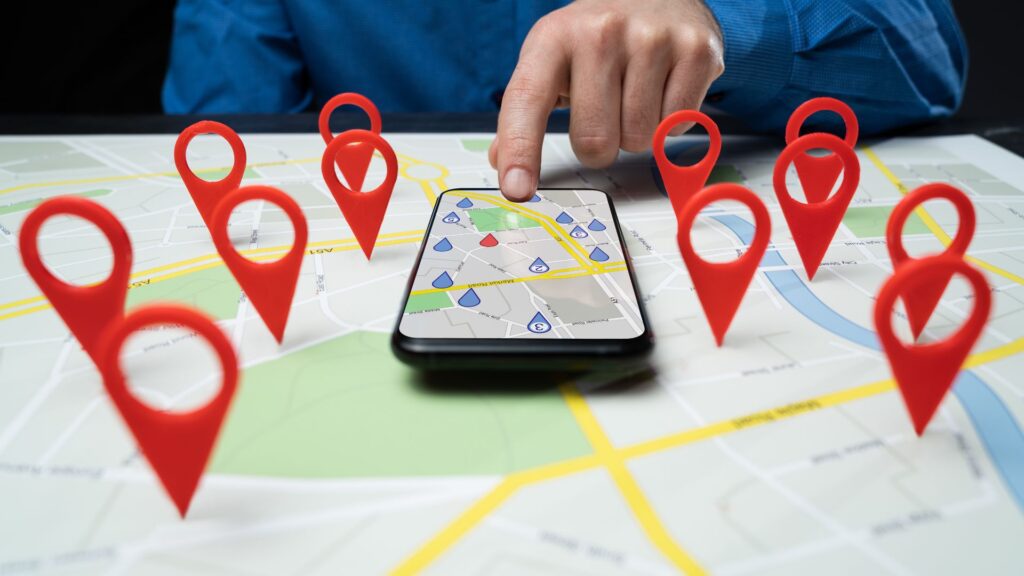
When intent is high, users move to maps. Searches like “near me” or location-based queries signal immediate action, and this is where Google Business Profile becomes critical — not as a directory listing, but as your primary conversion surface for high-intent searches.
Your presence on maps is evaluated instantly. Users look at your rating, your reviews, your photos, and your activity. A business with 4.8 stars and 200 reviews draws more trust than a competitor with 3.9 stars and 15 reviews — regardless of which one ranks higher organically. Recent, high-quality photos signal that the business is active and cares about its presentation. Missing or outdated photos create doubt. There is no long consideration phase, no deep research. There is a decision. This is why maps are not just a discovery tool — they are a conversion layer, and businesses that treat this as secondary often lose customers without understanding why.
AI: The Invisible Influencer
Alongside maps, another layer is shaping decisions even earlier. AI-driven answers — visible across Google Search in AI Overviews and increasingly through Gemini integrations — present users with direct summaries and recommendations before any organic listing appears. These systems do not pull from every business equally. They favour sources that are structured, credible, and consistent, meaning businesses with clear content, proper schema markup, and accurate information across platforms are more likely to be surfaced.
If your business is not part of these responses, you are not part of the decision — not because you ranked lower, but because you were never included. It is no longer enough to be discoverable. You need to be interpretable, structured in a way that AI systems can read and present confidently. Businesses investing only in traditional SEO are not preparing for this layer at all.
The Visibility Gap Most Businesses Miss
Most businesses assume they are visible. They have a website, they rank for certain keywords, they have a presence on maps — from the inside, it feels covered. But these elements often exist in isolation. Search brings traffic that does not convert because the map profile is thin. Maps show the business, but photos are outdated and the description has never been updated. Across multiple platforms, the name, address, and phone number are slightly different — inconsistencies that quietly erode trust in automated systems.
The result is fragmented visibility. Each channel exists, but they do not reinforce each other. That friction is invisible to the business but visible to the customer. The issue is not presence. It is alignment.
What Happens When Visibility Is Engineered
A fragmented presence, once aligned, changes performance dramatically. Before alignment, traffic arrives but bounces, reviews are sparse, the map profile feels inactive, and conversion is inconsistent despite effort. After alignment — with consistent information, active review management, and structured content — the same business shows up more credibly at every touchpoint.
The numbers reflect this. Businesses that align their visibility across Google surfaces see an average of +50% increase in clicks and +35% increase in impressions. The result is not just more traffic. It is more efficient traffic, because trust is established before the click, not during it.
Visibility Wins. Rankings Support.
Ranking still plays a role — it is part of the system. But it is no longer the objective. It supports visibility. It does not define it. What drives growth today is how consistently and effectively your business shows up across Google — search, maps, profiles, reviews, and the AI-driven surfaces where first impressions are increasingly formed. That is where discovery turns into trust, and where trust turns into action.
Turn Visibility Into Revenue
If your business is ranking but not consistently converting, the issue may not be effort. It may be presence. At Krenlo Digital, we help businesses build aligned visibility across Google — so that every surface works together and the customers looking for what you offer can find you, trust you, and choose you.
Call us at +91 8788424060 Email: info@krenlo.com
Because growth is not about being seen once. It is about being chosen every time.